Jay C. Yan
While one could never hope to fully catalogue the diversity of this planet’s desert-crossing endeavours, this document provides an outline of common practice. It primarily focuses on basic structure and organization, with limited attention to internal culture, more varied and requiring more care than can be discussed with brevity.
The Van#
Ranging ahead of the convoy, the Van is usually small, as little as a single vehicle or scout on foot. Pathfinders and surveyors, the Van tests the terrain with sensors and their own hide to ensure safe passage for the rest of the convoy. Without them, it would be far too easy for an entire convoy to be lost to a buried white sand deposit or sinkhole, or simply lose the route. Ground penetrating radar/sonar suites scan for white sand, unstable ground, and similar buried threats, while the crew use eyes, ears, and intuition to look out for other dangers. Arms and limited armor are also common in more violent areas; canny ambushes are often only found by sticking your nose in them, and it’s good to have some firepower to brandish when negotiating passage with bandits or local warlords. Medium vehicles, such as Camels or literal vans, dominate, possessing the capacity to operate independently and carry all the necessary equipment, without the ponderous weight of a Long Runner. They are otherwise kept fairly light for their size, often with aftermarket kits and larger tires to improve all-terrain capability. Despite physically leading the group, this is rarely a position for people high on the social ladder. It does not tolerate distraction. However, many a convoy leader or respected elder has experience in the Van, which demands and vindicates trust like nothing else.
The Train#
The bulk of the convoy, it’s what comes to mind to most Terra Novans when thinking about rovers, if they aren’t imagining bandits. Decoration and personalization abound, as these are not just vehicles, but the physical infrastructure of society, worn and patched up countless times. It is common to have a few smaller vehicles, the easiest to extract from a bad situation the Van might have missed, in the lead. This is also where backup vehicles and drivers in training for the Van reside. They are followed at a safe distance by the largest, the Long Runners and modified gear carriers, as they can compact the sand for those behind and take the longest to stop or turn. Due to limited space and time in most vehicles for domestic labor, communal cooking, laundry, childrearing, and sometimes rest tends to be done in the larger vehicles, or when encamped. Ultralight aerial vehicles, flying off the tops of the larger transports, may also be included for utility, communication, or additional surveying in support of the Van.
The Flock#
The many hangers-on of a convoy. Not always present, the Flock are, essentially, guests. “Hitchhikers” following along in personal vehicles (or in spare passenger space), smaller convoys, itinerant workers, or service providers are common constituents of the Flock. This arrangement provides much increased safety for the smaller party, and additional security for both in the case of mercenaries and independent suppliers (another water collector/tanker is always welcome). Your average “independent” trucker in the Badlands is making most journeys in the Flock of various convoys. The Flock most often has a transactional relationship with the convoy as a whole, one way or the other, but it’s also a place for family friends, lost travelers, or anyone else in need, as hospitality demands. If a private citizen needs to travel somewhere not serviced by rail and can’t afford a flight, they’ll probably need to hitch a ride in some convoy’s Flock. Be respectful, as hospitality demands.
In some convoys the Flock, or similar terms, also refers to unmanned vehicles, owned or escorted by the convoy. While not considered reliable enough to travel long distances on their own, ONNets or simpler automated systems are plenty smart enough to work as part of convoys with means beyond their population. Most convoys however, consider them just another part of the Train.
Animal Husbandry#
Depending who you ask, domestic animals like springers and tamaru are at least as important as vehicles. Some convoys exist entirely on the backs of these creatures, particularly those that wish to minimize dependence on fixed industry. While slower than vehicles in good terrain, and lacking enclosed accommodations, animals can better provide for themselves, and can go places where vehicles can’t. They’re a self-replenishing means of turning the environment, even the desert, into usable calories and trade goods. Even their waste can be sold for fertilizer or heating fuel. However, land use, particularly in the polar regions where it is more regulated, can be fraught. Disputes over grazing rights are some of the most common material conflicts between convoys, or between convoys and settlements. In league territory, grazing outside of private ranches and dedicated preserves for transhumance is often illegal. Convoys that maintain substantial numbers of livestock and/or pack animals will usually have dedicated veterinarians and other caretakers, as well as small vehicles and working animals, like shep dawgs, for herding and guarding. Even those that don’t can still have pets and working animals for other purposes. Despite being a literal flock, animals are generally directly-owned assets, classified here as part of the Train, but the practice of renting out livestock from settlements to be pastured elsewhere still exists in parts of the North.
Amenities#
Power and Mechanics: Most settlements are reliant on imported fuel, so every liter saved by a convoy is money earned. Thus solar or wind power for utilities and hybrid vehicles are valued. Solar cookers and stills, using fresnel lens panels to focus the sun’s heat, are rarely used, but they’re simple to maintain as backups for other systems. While some things are simply too large or complex to avoid carrying spares or patch jobs to keep them together, small fabricators and mobile workshops are a great way to produce new parts on demand with less material. These facilities can very well exceed those of small settlements, allowing convoys to serve as itinerant machine shops.
Water and Waste Management: While most places on Terra Nova extract their own water, they must carefully manage aquifers and condensers, and thus may charge a high price for outsiders. Even at the poles, clean surface water isn’t always available. Water conservation remains important, especially in case of emergencies. Reverse osmosis filters to help recycle waste water are omnipresent, making activities like bathing less wasteful. Air conditioning and heat pumps, invaluable against desert temperature extremes, also serve to condense and collect water vapor from interior air (a human loses about a liter per day from breathing and skin evaporation). Reducing mold and other condensation damage is a nice bonus. While recycling and reuse is the order of the day, trash still builds up, and managing it is an ongoing issue for convoys and settlements. Holding on to it until one can reach an appropriate disposal site is preferred, but thousands of cycles of human habitation mean that it’s not uncommon to run across litter left generations ago (which, depending on the type and quantity, can be a gold mine for archaeologists). Ironically human waste, once sterilized, has some value in the Badlands as fertilizer, where settlements need as much nutrient input as they can get.
Entertainment: Like anyone else, people on the move don’t like to be bored. Audio based entertainment is easily enjoyed while traveling: radio shows, audiobooks, poetry, music, tall tales and other storytelling. When performed by members of the convoy to others, this can also be an additional source of income, or at least a good way to make nice.
Communication#
Radio-based local area networks help keep a convoy together, but communication over longer distances can be spotty. Drones or light aircraft help extend radio range, and most oasis towers operate powerful transceivers, but there are many regions where having a single soul outside the convoy to talk to is a rare treat. The Hermes network, when it was consistently available, was a great boon in this respect, ensuring comms, news, entertainment, and weather reporting in all but the worst conditions.
Emergencies#
Inclement weather, such as a sandstorm, usually leaves little choice but to ride it out. When this becomes necessary, the Van will try to find as safe a spot as possible to gather the convoy together. Solid ground, places where sand won’t accumulate, elevation if flash floods are a risk. The larger vehicles can form a circle to serve as a windbreak for the smaller ones (whose occupants may also move to said larger vehicles), equipment is covered up, and everything is connected via tow lines. If one needs to move between vehicles, the lines prevent the nightmare scenario of getting lost in a blinding sandstorm, and if a vehicle is stuck or buried, it may be retrieved more easily. It also reduces the risk of dangerous static charges building up between different vehicles. The connections may include power cables, to communicate reliably and share electricity. Afterwards, everyone is accounted for, damage is evaluated, and compressed air blasters or brooms are used to sweep the dust off of everything. Parents menace children with tales of those who neglected to “rig up” properly before a storm, only to find someone, or everyone, missing afterwards. Many are based on real incidents within living memory.
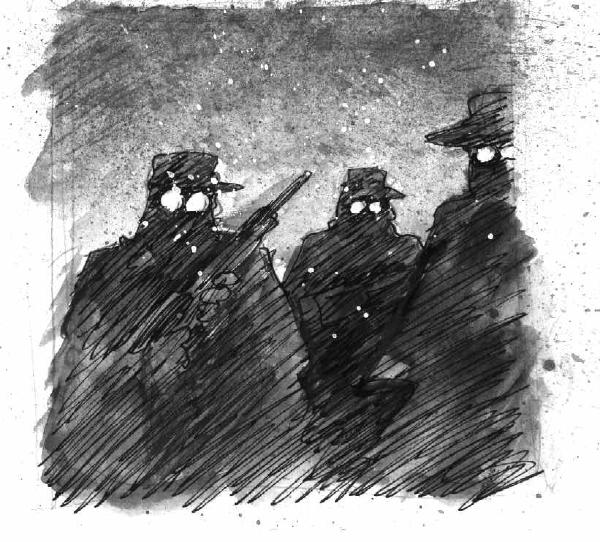
Against the heavy weaponry ever plentiful on Terra Nova, a typical convoy cannot prevent losses from a determined foe. Even some small arms and an IED in the right place can shed a lot of blood. Luckily, a burnt out husk of a truck is also of little benefit to a thief. There is a complex dance of threat displays, duels, and restricted combat if things should come to violence, but most often the bandit or occasional warlord is little more than the toll man, maintaining an area (either a permanent territory or a range through which they roam) where they can extract tribute from passersby without a fight. Most of the shooting is actually to prevent encroachment from others of their ilk (particularly for settled bandits). Nonetheless, if an example needs to be made, it only takes so much armament to make a convoy pay dearly for noncompliance. The few major mercenary companies on Terra Nova often make a living from governments, corporations, or pooled contracts with associated convoys as a sort of bait trap for this behavior. Hidden amongst a convoy, even if the mercenaries cannot perfectly protect them, any significant loss they inflict can be crippling for a bandit group. This often spells their doom as their neighbors pounce on weakness, and in the long run forces caution against wanton violence. Unfortunately, an upset like this can also cause another group to snowball in power, which in turn tends to draw in government forces.