With most Terra Novan leagues claiming descent from the pre-ice age cultures of Earth, it was almost inevitable that the oft-reinterpreted holiday of Christmas would be refurbished as a convenient source of iconography and continuity. Christmas on Terra Nova is generally agreed to fall on 25 Autumn, and its celebration has taken various forms throughout the centuries, with various traditions falling in and out of favor.
The North#
The Northern Lights Confederacy generally tends to take a dim view of Christmas. Sorrento Revisionist antipathy towards anything associated with Jerusalemism. Even the more secular charity-focused version of the holiday is seen as representation of what Second Follower Ryon Speck called the “obsessive Jerusalemite tendency to sacralize every act of common decency; so that by performing it once a cycle they feel they have emancipated themselves from the obligation to do it at any other time.” Christmas celebrations are seen as a negative stereotype of Jerusalemite foolishness, regardless of its similarity to Prophet’s Blessing, and the fact that the other Northern Leagues celebrate it is a key point brought up by isolationists. (Most Jerusalemites in the Confederacy do not, in fact, celebrate Christmas, as Clearwater Jerusalemism is descended mainly from Judaism and Islam. The stereotype remains anyway.) The Apostate Revisionists, however, do tend to celebrate Christmas, having inherited the practice from its origin in the Eastern Sun Emirates. Adrianna Xing has insisted on the existence of a Christmas tradition separate from any actual Jerusalemite beliefs that is focused on the idea of helping the needy that Revisionists should aspire to. Apostate Christmas as practiced in the NLC is largely an adaptation of the Western Revisionist tradition, though with influence from the Emirati one and a handful of elements from other regions (such as the character of “Ol’ Scrootch”). This has led to constant attacks by the Prophet’s Shield upon the Apostates for having contaminated themselves with Jerusalemism. As Apostasy has become increasingly popular in the NLC, wealthy Apostates have taken to throwing extravagant Christmas parties specifically to enrage their enemies.
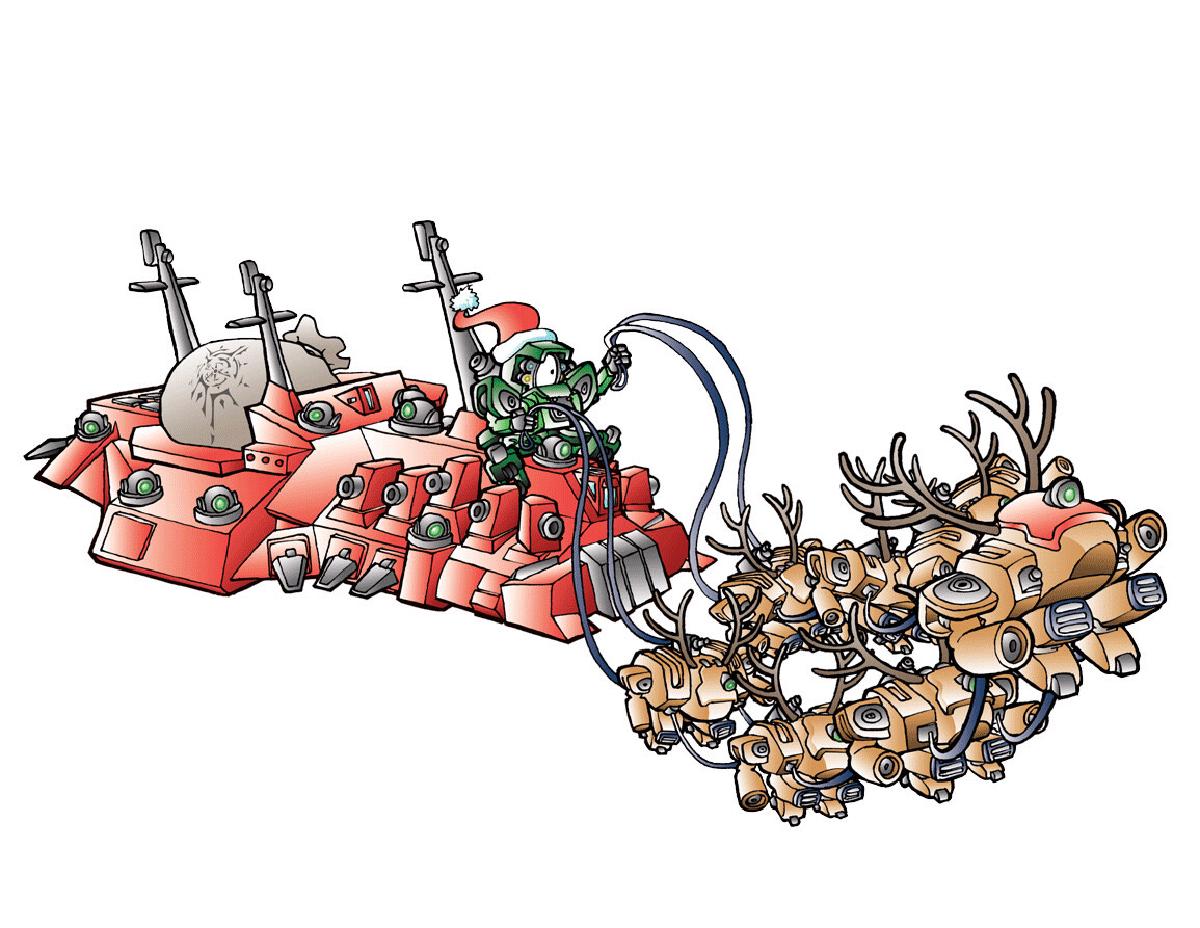
The United Mercantile Federation, on the other hand, has a more prominent place for Christmas than any other league on Terra Nova. There are in fact two competing versions of Christmas in the UMF, the secular “Lyonesse” version and the intensely Jerusalemite “Swanscombe” variation. Lyonesse Christmas is more of an aesthetic than a holiday: trees, snow, gift-wrapping, Santa Claus. Christmas imagery dominates Autumn and in recent cycles has even extended back into late Summer. This saturation comes largely from the fact that companies universally use Christmas imagery to advertise products introduced around that time, and it has become accepted to the point that academic studies have shown that new products debuting in early Autumn without Christmas-themed advertising have statistically notable lower sales. To the extent that Christmas Day is celebrated it is with a near hyperfocus on the giving of presents, preferably expensive ones. A culture of shaming people who do not buy Christmas presents for their friends and family has developed, largely by the well-off who can easily afford it.
Swanscombe Christmas is a Jerusalemite reaction to the Lyonesse version, seeing the commercialized imagery as a perversion that has led people astray from celebrating the miracle of the virgin birth. Swanscombe Jerusalemites reject most of the imagery otherwise associated with the holiday, focusing solely on the nativity scene of the births of Christ and his sister Sophia. Santa Claus and his derivatives are seen as false prophets, and if gifts must be delivered by a character on Swanscombe Christmas it is invariably one of the children of Mary. An even bigger deviation is that Swanscombe Christmas is not celebrated on 25 Autumn, but instead on whatever day corresponds to 25 December on Earth. A special office in Saint Justine’s Convent is dedicated to tracking this date and keeping the faithful informed of it. This has largely had the opposite of the intended effect, as most members of the church have come to treat the two holidays as entirely separate events and celebrate them both, infuriating church leadership.
Christmas in the Western Frontier Protectorate is an odd hybrid, caught between Revisionist disdain for Jerusalemite rituals and the desire to continue practicing ancestral traditions. As such, Western Christmas celebrations are injected with Revisionist ideas, presenting Santa Clós as a manifestation of the sympathic force of Gentle Spirit, manifesting into the world to distribute the fruits of piety and good works in the form of presents (he is also, for reasons lost to time, a wrestler). Christmas is typically celebrated within the clan, and in smaller clans it is not uncommon for every member to be present for Christmas dinner. Larger clans tend to have multiple separate Christmas meetings, but the most powerful of the First Clans invert the trend and temporarily set up colossal meeting places in repurposed warehouses where the majority of the members can meet up. Active-duty WFPA members below the rank of Brigadier are generally expected to spend Christmas with their regiment instead; most longstanding regiments have distinct Christmas traditions which tend of combine festivity with a great deal of pranks and hazing.
The South#
In the Southern Republic, Christmas has largely been assimilated into the more popular Saturnalia, which also falls upon 25 Autumn. While Saturnalia is primarily a celebration of freedom, it has appropriated the gift-giving traditions of Christmas, now recontextualized as an exercise of one’s free will to bestow things upon others. The inevitable attribution of the distribution of these gifts to Père Noël’s annual circumnavigation of the Republic in his crocodile-pulled boat is also seen as an expression of the freedom to conceal one’s identity when necessary, and seen as an important tool for teaching children the importance of the noble lie. Another Christmas figure who has become indelibly associated with Saturnalia is Pére Fouettard, who traditionally appears at the end of the day to unseat the Lord of Misrule and return authority to its rightful place with the State. Fouettard and his whip are also commonly used by Republican parents as a boogeyman to scare children into behaving before they have reached the age where the Ministry of Justice takes over the role.
Christmas is not an official holiday in the Mekong Dominion, but parts of it have made it into the general culture since the formation of the AST thanks to the influence of Saturnalia. With the de-emphasis of the frivolity and chaos that characterizes the Republican holiday, the Christmas elements are given more weight, to the point that both “Saturnalia” and “Christmas” are considered valid names for the day. Gift-giving is expected to occur within a corporation that has been profitable, with the gift from the corporation to its employees as a whole to its usually taking the form of an expenses-paid fried hopper dinner. Supervisors are expected to get gifts for their immediate subordinates, which are usually small or cheap. A more expensive gift is a sign of affection towards a subordinate, and if they are interested in a mutual relationship they are expected to respond with a similarly large gift a few weeks later on Labor Thanksgiving. This has been the foundation of more than a few sticky and unethical situations when the interest is one-sided.
Christmas in the Humanist Alliance has been carefully cultivated by the Preceptors since shortly after the league’s formation by Yuri Gropius, despite the general policy of state atheism. Christmas celebrations were popular enough that eliminating them seemed politically unwise, and the idea of a ceremony encouraging communal giving seemed in line with the general ideological goals of the Humanist project. Multiple attempts to find some sufficently secular reference from the classical era that could be easily reconciled with Humanism generated several obscure failures before finally landing on the story of Abenezer Skroutz, the wealthy man who despised the poor and the weak until he was enlightened by a series of visions dedicated himself to helping them instead. Skroutz was seen as an important example to Commoners about the necessity of communal contribution, and quickly became the established giver of gifts to Humanist children. Efforts by the government have sometimes been made to fully remove any mysticism from the tale by portraying the three Christmas Ghosts as merely Skroutz’s own fevered hallucinations, though this has not stopped government-commisioned portrayals of the character from being accompanied by the spirits of Ignorance and Want, who have finally been taken under the responsibility of man thanks to the benevolent efforts of the Perceptors. (The Christmas Ghosts have occasionally also been portrayed as representing the three Humanist castes, though nobody can agree which is which.) Under Republican occupation, Skroutz and the celebration of Christmas in general became a popular symbol of resistance to deracination.
The Eastern Sun Emirates are another league with dual Christmas traditions. As part of their general appropriation of Jerusalemite imagery the Emirs tend to throw lavish Christmas parties that are not particularly different from any of the other ones they host the rest of the cycle aside from the contents of the feasts being slightly different. Some individual emirates have local variations like the tree-lance duels between gears in the Cimmaro Coliesum, but these are still a purely elite activity exclusive to the Emirs and their servants. Only in Javari, where the influence of the banderias and the heavy Jerusalemite presence lead to some ritualized distribution of food and gifts to the poor, is Christmas recognized as an official holiday. And yet every Autumn 25 Christmas is celebrated by Shajhalin across the Emirates anyway. Originally in line with the more public celebrations of other leagues, Christmas activity was forced underground due to Malach Masao’s ban on organized religion and never publically resurfaced even after the ban was lifted. Shajhalin Christmas is generally a quiet meeting of a handful of families who exchange small gifts with each other but is primarily considered a time for prayer, whether Jerusalemite or as is increasingly more common, Apostate Revisionist.