This is the rebuilt Dream Pod 9 Community Blog.

Currently content and layout is being updated and reformatted. (again)

Articles

Guides

Editorial Policy

Please contact prof9844 on the Discord for questions about content.

The Heavy Shooter Dartjäger

OACS-O1M/HRRV HEAVY SHOOTER DARTJÄGER
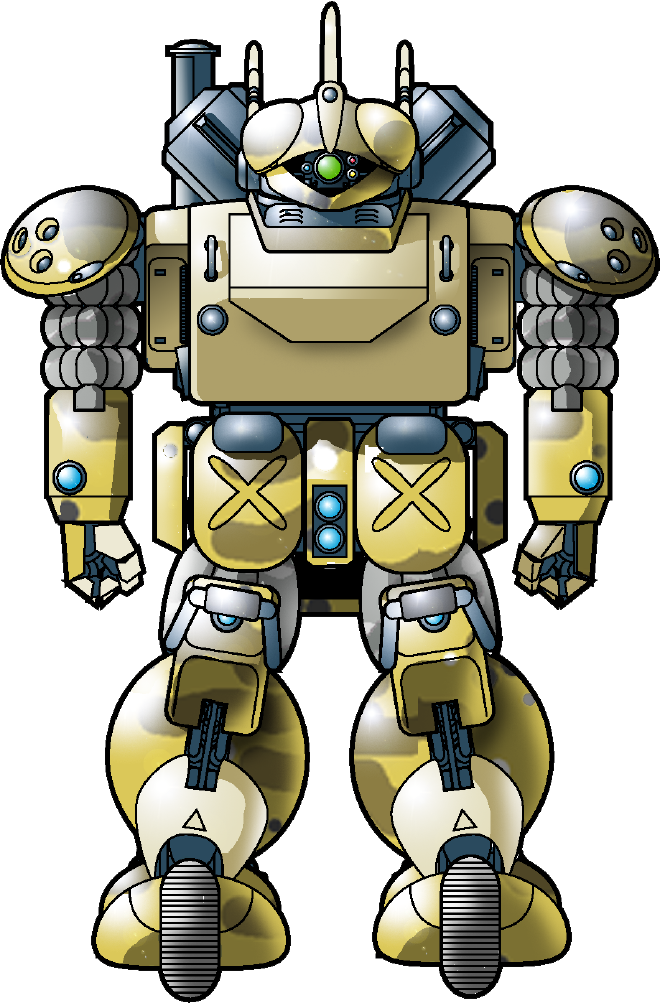
The Dartjäger rapid deployment vehicle has had a distinguished period of service, being deployed across the Badlands and the Antarctic to deal rapidly with trouble spots. The relatively light weapons payload of the Dart has been problematic for its pilots, however. Deploying well ahead of any fire-support units, Dart pilots can rapidly find themselves out-gunned if the opposition they face proves greater than anticipated by intelligence reports. A rapid-deployment fire-support vehicle was needed to travel alongside Dartjägers, so MILICIA technicians set to work. It was critical that the unit — dubbed the Heavy Shooter — be able to match the standard Dart pace for pace, so it quickly became clear that multiple heavy weapons would prove too heavy for the task at hand. A Rucker unguided mortar was chosen for its durability and low price-tag; all other weapons were stripped to save weight. The disadvantage of the mortar is its inability to fire at close range, forcing the Heavy Shooter to hang back from the main body of the unit it is supporting. In 1950 the success of the Dartjäger led to it being a test platform for more powerful mortars. Similar in size to the previous mortar, the newer weapon system provides an improved payload, while remaining lightweight, at the expense of a bit of ammunition storage. These changes have made it less effective in prolonged engagements, but still ample for the shorter skirmishes it’s designed for. To prevent a failure of communication due to harsh conditions or electronic counter measures, the Gear is also equipped with an Obelisk Electronics VOX-90 communications system.

[Read More]
Categories: blitz rpg  Tags: HGB3.1 

The Shepherd's Trail, Part 5: The Economy

From an economic perspective, the Church determined early in its colony planning to focus on agriculture. New Jerusalem’s climate, with its fertile soil (compatible with all forms of Earth plant life after some modification) and massive network of rivers, made it an ideal farming colony. Vast fields of crops and herds of animals spread over the planet, with the occasional hub for the residents to turn in crops and products as well as receive services. These hubs would eventually form the core of the cities that would later dot the world. The Church maintained complete control of interplanetary trade. Anything that went off world or came to New Jerusalem was handled directly by the Church. Raw materials were collected, processed, packaged, and mostly shipped back to Earth or the other colonies. What was left was used to provide food to the population. Metals and other geological resources were also shipped off-world, but a larger portion were used to produce machinery, parts, and other critical equipment. The materials shipped out were sold, and the funds were used to bankroll new colonist waves and the purchase of materials that could not be produced locally.

[Read More]
Categories: background  Tags: Economics 101 

The Shepherd's Trail, Part 4: Colonization

The initial colonization of New Jerusalem was sparse, focused mostly on Church personnel with a goal of setting up habitation areas for future waves of colonists. Calling upon their relationships with various companies, the Church was able to negotiate large purchases of equipment and hardware to ship to the fledgling colony. Workshops were set up in orbit and on the surface to maintain and support the new infrastructure. Eventually negotiations led to actual production facilities on New Jerusalem, allowing the Church to independently sustain its colony.

[Read More]
Categories: background  Tags: Theological Reentry 401 

The Shepherd's Trail, Part 3: Timekeeping

New Jerusalem orbits the start Nereus approximately every .97 Earth years. This single rotational cycle is called a year, which is divided into 375 days. These are broken into 12 months, each of 31 or 32 days. The months are Nisan, Iyyar, Sivan, Tammuz, Ax, Elul, Tishri, Marheshvan, Kislev, Tevet, Shivan, and Adar. The months of Tammuz, Marsheshvan and Adar each have 32 days and the rest have 31. Days are grouped together into 7-day weeks, and the names of the days are consistent with Earth’s. Seasons are approximately three months, with Nisan being the start of the northern hemisphere’s summer.

[Read More]
Categories: background  Tags: Timekeeping 101 

The Shepherd's Trail, Part 2: The Founding of the Church

The history of the Jerusalemite faith dates to the beginning of the Second Ice Age. Officially starting in 2422, this ice age was the harshest in the geological record. Humanity’s population was devastated, and the results of the mass movement of people towards the equator would fundamentally change human society. Mass famine and conflict over the remaining accessible resources reduced the human population to 2.2 billion by the year 2850. This led to a rise in religious sentiment across all of humanity. Many found solace in the faiths of their ancestors. Nations which had generally pushed back against religious influence in government now found religion taking on a more central role in politics. In 2835. the nations dominated by ancient religions formed the Council of True Faith. Not everyone attached themselves to an existing faith, and new religions sprouted up during the ice age’s early centuries. Described as ‘doomsday cults’ by many, the truth is more nuanced. These new faiths tended to focus on the near apocalyptic nature of the ice age and humanity’s response to it. Some were offshoots of existing faiths which believed their prophesized doomsday had come and gone, while others focused more on the idea that a person is not promised a tomorrow. This latter group was comprised mainly of ultra-survivalists, ready and willing to do what must be done to survive. By the 29th century, these new faiths had become dominating forces in many nations. Three months after the Council of True Faith was declared, the Compact of Revelations was formed to counter it. 

[Read More]
Categories: background  Tags: Theology 101 

Perseus Rapid Recon

PA-PX07 Perseus

The Perseus was one of the latest designs to originate from the depths of the Paxton Karaq Wastes Research and Development facility. Meant to serve in a multi-role scout/harasser capacity, the Perseus’s primary mission would be to detect any large force heading towards Peace River, perform hit and run attacks along their entire advance, and to continue to do so in their rear once the enemy force had reached their destination.

[Read More]
Categories: blitz hobby  Tags: HGB3.1 

The Shepherd's Trail, Part 1: New Jerusalem

Hello, everyone! Today, we start off on our road to exploring New Jerusalem in preparation for their arrival in Heavy Gear Blitz and the Roleplaying Game. The way this is going to work is that each week for the foreseeable future I am going to post a bit about New Jerusalem’s history, peoples, geography, etc, so we can explore this new world together. We will also have a quick little story to go along with the lore of each one.

[Read More]
Categories: background  Tags: Astronomy 101 

Guag Caprice Engineering Mount

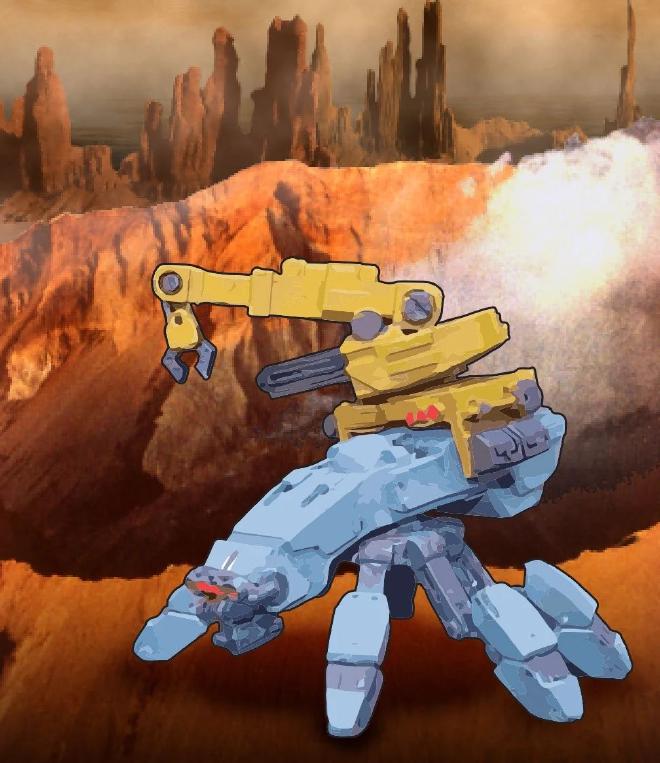
Hamath Guag

The Hamath Guag is a newer variant of the popular Hamath mount. The Guag’s creation can be directly attributed to the CEF’s initial failure to secure all of Terra Nova. The drawn out conflict was not something that Caprician military forces were prepared for, and equipment was found lacking in some areas. One major area is battlefield recovery. Due to the size and shape of mounts, traditional recovery methods are hard to utilize. Mounts cannot be readily towed by other vehicles and their legs tend to sprawl out when placed on transport. The Guag uses a crane and a series of pulleys to lift immobilized mounts (or portions of them) while field repairs are performed. The Guag cannot reliably haul other mounts around or tow them back to a field depot. To help keep it safe while it is doing repairs, the Guag mounts a small rotary cannon with a limited ammo supply. This has not proven to be a major issue though as Caprician units tend to hold position around mounts being recovered. This not only protects the Guag but also is critical to ensure potentially recoverable mounts don’t fall into enemy hands.

[Read More]
Categories: blitz hobby  Tags: HGB3.1 Modeling 

Heavy Gear RPG Extended Content

Hey everyone, Prof here!

Today we are rolling out V1 of the RPG’s Extended Content document. We want all of this in one place for players and directors to be able to refer to at once. Periodically we will update this document with batches of new content or even rotate things out as they get published in official content. The Hanger will be an additional document but that is far from ready yet and likely won’t be online until after launch. Additionally the first wave of canon characters is going to the artists now so we will see some of those soon.

[Read More]
Categories: rpg updates  Tags: PDF